
 English

Views: 0 Author: Site Editor Publish Time: 2026-11-21 Origin: Site


Choose a bridge rectifier by checking the electrical load path first, then the thermal path. In a bridge rectifier, each half cycle conducts through a pair of diodes in series with the load while the opposite pair is reverse-biased. Package thermal data is meaningful only when its measurement conditions are understood. Rectifier-diode standards help align terminology, ratings, measuring methods, test scope, endurance-test language, and marking, but they do not prove that any specific supplier part is qualified without product-specific evidence.
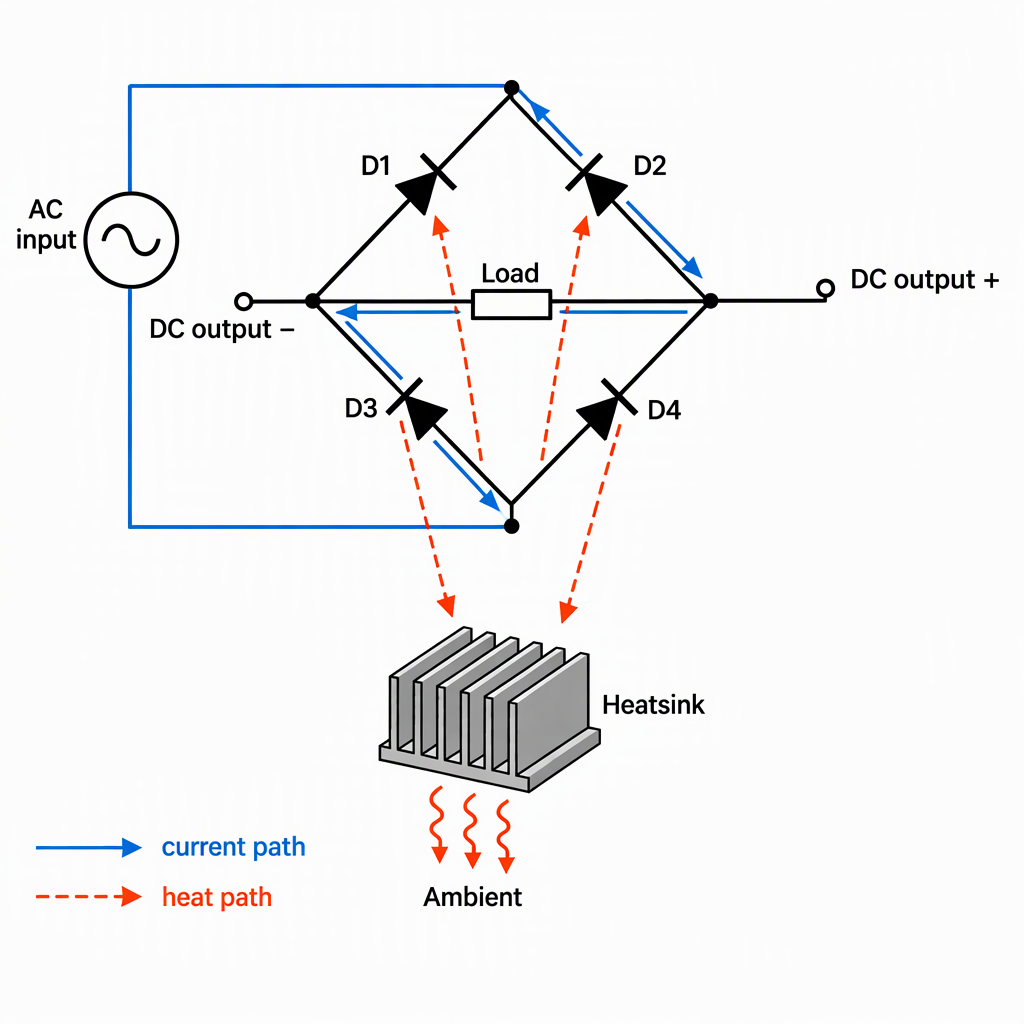
A bridge rectifier converts both half cycles of an AC input into load current without requiring a center-tapped transformer, and the conducting path includes two forward-biased diodes in series with the load.
That operating path matters because the selected part is not only a symbol on the schematic. The diode pair that conducts on one half cycle must carry the application current, while the opposite pair must withstand reverse voltage. On the next half cycle, the roles swap. For bridge rectifier selection, connect the load-current requirement, reverse-voltage requirement, package style, and heat path before accepting a part number.
The qualitative bridge operation described above is consistent with the UCSB physics demonstration page for a bridge rectifier, which explains the alternating diode-pair conduction path and the absence of a center-tapped transformer.
Load current should be treated as both an electrical-current requirement and a heat-generation concern because the load path contains two conducting diode drops during each half cycle.
A useful selection conversation starts with the expected current waveform, not only a headline current rating. Ask whether the supply is continuous or intermittent, whether the load has surge or inrush conditions, and whether the rectifier is mounted where heat can leave the package. The bridge principle shows why this matters: current flows through a conducting diode pair, so conduction loss and reverse blocking both belong in the approval review.
Selection question | Why it matters | Buyer action |
|---|---|---|
What current must the bridge conduct in normal operation? | The conducting pair is in series with the load, so the selected rectifier must be suitable for the load-current path. | Compare the application current profile with the supplier datasheet conditions. |
What reverse voltage appears on the non-conducting pair? | During each half cycle, the opposite diode pair is reverse-biased. | Confirm reverse-voltage margin before approving an alternate. |
How much heat can leave the package? | Two forward diode drops are in the conducting load path. | Do not approve by current alone; move to the thermal review. |
A single current number is not enough when the duty cycle, mounting, ambient temperature, or heat path changes, because junction-temperature and package thermal data must be interpreted under stated measurement conditions.
Thermal approval should check junction-temperature assumptions, package thermal measurement conditions, mounting conditions, and the expected ambient environment before the current rating is accepted.
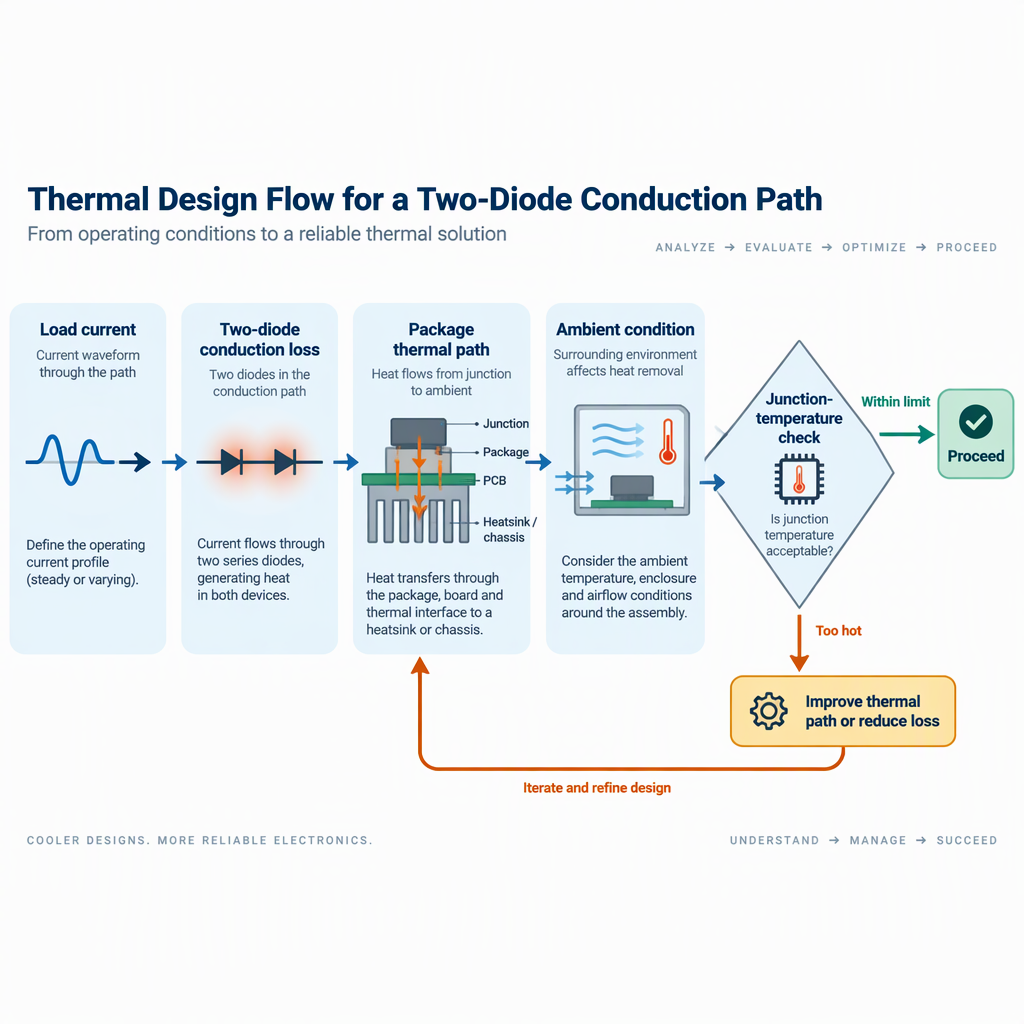
JEDEC describes JESD51 as a methodology for thermal measurement of single semiconductor-device component packages and states that following the methodology provides meaningful data for determining junction temperature under specific conditions. That wording is important for bridge rectifier selection: thermal resistance data becomes useful only when the buyer understands the test condition and compares it with the real assembly.
Define the bridge conduction case: current flows through one diode pair on one half cycle and the opposite pair on the next half cycle.
Collect the supplier thermal parameters and the conditions used to measure or characterize them.
Compare those conditions with the planned PCB copper area, lead length, enclosure airflow, heat sinking, and ambient temperature.
Check whether the calculated or estimated junction temperature remains inside the supplier limits for the actual duty cycle.
Use JESD51 as a package thermal-measurement methodology rather than a bridge-rectifier product-selection rule by itself.
A practical bridge rectifier selection table should include the bridge current path and reverse-voltage duty. It should also include package thermal conditions. Where standards are referenced, it should separate test terminology from product-specific qualification evidence.
For R&D, quality, and procurement teams, the table below keeps the conversation focused on data that must be confirmed before an RFQ or alternate approval. It avoids treating package name, current rating, or price as a complete engineering decision.
Criterion | What to confirm | Selection consequence |
|---|---|---|
Bridge operating path | Two diodes conduct in series with the load during each half cycle. | Account for conduction loss and package heating. |
Reverse blocking | The non-conducting pair is reverse-biased during each half cycle. | Check reverse-voltage rating and transient exposure. |
Thermal data | Thermal measurement data is meaningful under defined conditions. | Compare datasheet conditions with the real board and enclosure. |
Test terminology | IEC 60747-2:2025 covers rectifier-diode terminology, ratings, characteristics, measurement and test methods, type tests, routine tests, endurance tests, and marking. | Use standard language to request comparable supplier documents. |
Record the required average, surge, and duty-cycle current data from the application.
Record the maximum reverse-voltage exposure and any transient-protection assumptions.
Ask for package dimensions, mounting recommendations, and thermal characterization conditions so package thermal data can be compared with the assembly conditions.
Request datasheet limits, marking information, and test-method references that apply to the exact ordering code under review.
Do not select a bridge rectifier as if any fast or small-signal diode can replace it; the bridge part must satisfy the rectifier current path and reverse-voltage duty of the power circuit. Thermal suitability still depends on package conditions and junction-temperature interpretation.
Decision area | Bridge rectifier selection | Small-signal or switching-diode substitution risk |
|---|---|---|
Current path | The load current passes through a conducting diode pair in the bridge. | Topology alone does not show that a small diode can carry the application current. |
Reverse-voltage duty | The opposite pair is reverse-biased during each half cycle. | Reverse rating and transient exposure still need datasheet confirmation. |
Thermal approval | Package thermal data must be interpreted under stated measurement conditions. | A part that switches quickly is not automatically thermally suitable for rectifier load current. |
Terminology and tests | IEC 60747-2:2025 includes rectifier-diode categories such as generic rectifier, avalanche rectifier, fast-switching rectifier, and Schottky barrier diodes. | Category language helps frame the request, but the exact product evidence still must come from the supplier. |
A standard category or diode family name should not be treated as proof that a particular device has passed a particular qualification program. Ask for the datasheet, test report, or declaration that applies to the exact device and revision.
Use rectifier-diode standards to align terminology and requested test information, but require supplier-specific documents before claiming product compliance or qualification.
The official page for IEC 60747-2:2025 identifies edition 4.0, publication date 2025-09-29, and stability date 2030, and describes scope covering terminology, letter symbols, essential ratings and characteristics, measuring and test methods, type tests, routine tests, endurance tests, and marking for discrete rectifier diodes.
That scope is useful when engineering and quality teams want consistent language in an RFQ, drawing note, or incoming-inspection plan. It does not by itself show that a specific supplier’s bridge rectifier is certified, qualified, or tested to a particular requirement. Keep the standard reference and the product-evidence request separate.
If compliance language appears in a quotation or datasheet, ask the supplier to identify the exact standard edition, product family, ordering code, test basis, and document revision that support the statement.
Before sending an RFQ, define the bridge operating path, current requirement, and reverse-voltage exposure. Add the mounting and thermal conditions needed to interpret package data. Then request the exact product documents, markings, and test-method references that apply to the ordering code.
State the input waveform and explain that the bridge must conduct load current through the alternating diode-pair path.
Provide normal load current, surge or inrush expectations, duty cycle, and maximum reverse-voltage exposure.
Provide mounting details, PCB copper assumptions, enclosure airflow, ambient-temperature range, and any heat-sinking expectations.
Request thermal parameters together with the measurement or characterization conditions used to produce them.
Request datasheet limits, marking information, and any applicable test-method or qualification documents for the exact ordering code.
Ask procurement to quote only parts whose datasheet, package, marking, and approval documents match the engineering review.
The safest bridge rectifier choice matches the real current path and reverse-voltage duty. It also matches the actual thermal environment and package conditions. Where standards are used, the final approval should rely on product-specific documents rather than a general standard reference alone.
The bridge topology puts two conducting diodes in the load path during each half cycle.
Thermal data is meaningful only when its measurement conditions are understood.
Standards can align language and test scope, but product proof must come from product-specific supplier documents.
These quick answers help engineering, quality, and procurement teams check bridge operation and electrical stress. They also keep thermal conditions in view before part approval.
Start with the load-current path and reverse-voltage exposure. A bridge rectifier conducts through one diode pair while the opposite pair is reverse-biased, so both current and voltage stress must be reviewed.
In the bridge load path, two forward-biased diodes conduct in series during each half cycle. That makes heat review part of current selection.
No. Thermal data and junction-temperature estimates depend on stated measurement and mounting conditions, so the current rating must be checked against the real board, enclosure, ambient temperature, and duty cycle.
Ask for current and reverse-voltage requirements that match the bridge operating path. Ask for thermal data with measurement conditions. Ask for the exact ordering code, datasheet revision, package details, marking, and product-specific qualification or test documents required by engineering.
No. IEC 60747-2:2025 defines scope for rectifier-diode terminology, ratings, characteristics, measurement and test methods, type tests, routine tests, endurance tests, and marking; it does not prove a specific product is qualified without supplier evidence for that product.
Use JESD51-related thermal data as condition-specific package thermal information. Compare the stated measurement conditions with your PCB, airflow, heat sink, enclosure, and ambient assumptions.
Not without a full electrical review of the load-current path and reverse-voltage duty. The bridge application also needs package and heat-path review, not merely diode switching behavior.


