
 English

Views: 0 Author: Site Editor Publish Time: 2026-11-20 Origin: Site


Schottky diode leakage that looks acceptable at room temperature can become a design, quality or sourcing issue on a hot board; treat temperature as one major variable, then separate it from reverse-voltage stress, thermal path, package conditions and measurement setup before changing the diode.
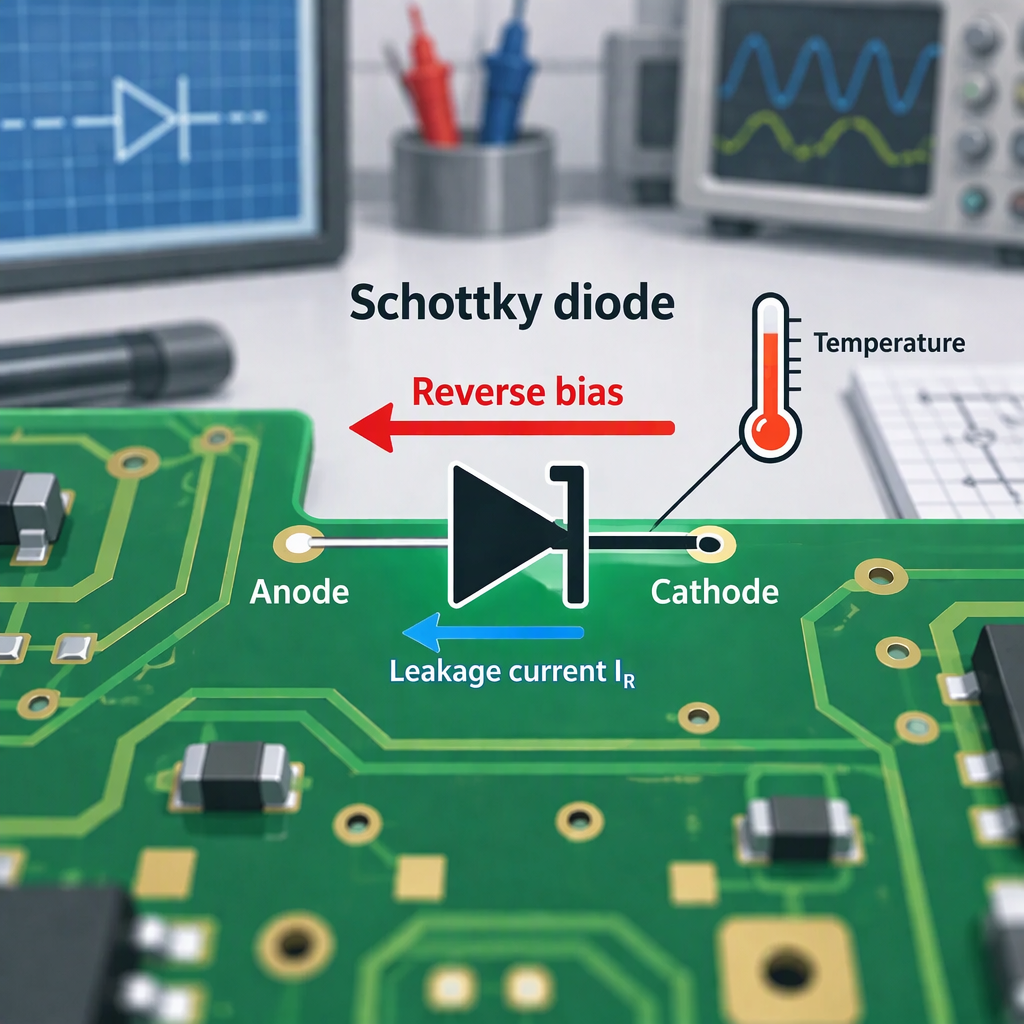
Schottky diode reverse leakage is temperature-sensitive because current mechanisms at the metal-semiconductor barrier can include thermionic emission and tunnelling, and reverse-bias behaviour can also be influenced by voltage, defects and edge effects.
For selection work, the important point is not that every Schottky diode follows one identical curve. The practical point is that leakage must be reviewed at the intended reverse voltage and operating temperature, not inferred only from a 25 °C reading or a headline forward-voltage value.
Do not treat “high temperature” as a complete root cause. A hotter junction can make reverse current more visible, but the observed reading can also change when reverse voltage, board heating, package thermal path, junction defects or edge-related behaviour changes.
A Scientific Reports study of silicon carbide Schottky barrier diodes describes fundamental current mechanisms over temperature and voltage ranges. Use that physics context for mechanism thinking, not as a leakage rating for every silicon Schottky diode or any specific supplier part.
Start with the symptom pattern: when the leakage appears, at what reverse voltage, at what board or junction temperature, and whether the reading follows temperature consistently after the test setup is repeated.
Observed symptom |
Likely area to check first |
Next action |
|---|---|---|
Leakage rises mainly when the board is heated. |
Temperature-dependent reverse current mechanisms. |
Repeat the reading at the same reverse voltage and controlled temperature points. |
Leakage changes strongly when reverse voltage changes. |
Reverse-bias stress and voltage-dependent current behaviour. |
Confirm that the selected diode has adequate reverse-voltage margin for the real circuit condition. |
Only one lot, board area or thermal condition shows abnormal leakage. |
Thermal path, edge effects, defects or measurement variation. |
Compare boards, packages and lots under the same controlled setup before replacing the approved device. |
For powered equipment or live assemblies, switch off and disconnect the relevant power source before any manual access, probing setup change or component handling. Follow the model manual’s permitted access instructions and do not bypass guards or safety interlocks.
Select a Schottky diode by matching leakage, reverse-voltage margin, thermal condition and package assumptions to the actual hot-board use case rather than choosing only the lowest forward-voltage option.
Check reverse leakage at the temperature range and reverse voltage that resemble the circuit condition.
Review whether reverse-voltage derating is adequate when transients, tolerance and hot operation are combined.
Compare package thermal path and board copper assumptions with the target layout instead of relying on a package name alone.
When considering Dongguan Merry Electronic Co., Ltd / Merryelc, treat the homepage category listing for Schottky Diode and SiC Schottky Diode as category-level availability only; request the exact datasheet and leakage curves for the candidate model.
Ask suppliers for test conditions, temperature points, reverse-voltage conditions and lot-control information when leakage is a quality-critical parameter.
Selection factor |
Why it matters for leakage temperature |
Buyer check |
|---|---|---|
Reverse leakage rating |
Reverse current behaviour can vary with temperature and voltage. |
Compare ratings only at the same temperature and reverse-voltage condition. |
Reverse-voltage margin |
Voltage-dependent mechanisms can affect reverse-bias current behaviour. |
Confirm margin against steady-state, surge and tolerance conditions. |
Package and board thermal path |
Hotter operation can shift the leakage budget even when the schematic is unchanged. |
Retest on the intended PCB layout or a representative thermal setup. |
Forward-voltage tradeoff |
Low forward drop is valuable, but it should not hide leakage and thermal limits. |
Evaluate conduction loss and reverse leakage together. |
Use a controlled retest plan that records temperature, reverse voltage, device state, measurement method and sample identity before comparing leakage values across suppliers or design changes.
Define the circuit condition: maximum reverse voltage, expected board temperature, transient exposure and acceptable leakage budget.
Measure leakage at matching reverse-voltage conditions because reverse-bias current behaviour can be voltage-dependent.
Repeat the measurement at controlled temperature points and allow the setup to stabilize before recording values.
Use the same fixture, instrument range and handling process when comparing a baseline part with a replacement candidate.
After changing package, copper area or derating rule, retest the final board condition rather than relying only on bench component readings.
Record ambient, case or board measurement location and the time allowed for thermal stabilization.
Record reverse voltage, polarity, instrument range, sample count and lot or date code.
Keep pre-change and post-change readings in the same template so quality and sourcing can compare conditions, not just numbers.
IEC 60747-2:2025 is an International Standard for discrete rectifier diodes, including Schottky barrier diodes, and its public scope covers terminology, ratings and characteristics, measuring and test methods, type tests, routine tests, endurance tests and marking. That makes it useful for test-scope language, but it does not prove that any specific device is qualified to the standard.
Engineering should hand purchasing and quality a leakage requirement package that states the operating condition, acceptable limits, required documents and retest method, instead of asking only for a generic Schottky diode replacement.
Required reverse-voltage rating, surge assumptions and derating rule.
Target leakage limit at the relevant temperature and reverse-voltage condition.
Package, PCB copper and thermal environment assumptions.
Required datasheet pages, leakage curves, test conditions and change-control expectations.
If IEC 60747-2:2025 terminology or test-scope language is referenced, state that it supports diode terminology and test-method context, not automatic product qualification.
If Dongguan Merry Electronic Co., Ltd / Merryelc is included in sourcing, ask for model-specific datasheets for the listed Schottky Diode or SiC Schottky Diode category rather than assuming homepage category text contains leakage ratings.
Do not approve a substitute solely because the package and nominal voltage match. Leakage at the hot operating condition can be the limiting requirement even when room-temperature checks look similar.
Use the leakage requirement package as the request format for suppliers: include the operating temperature, reverse voltage, package, derating expectation and retest conditions before comparing quotes or samples.
The safest selection path is to diagnose the leakage pattern first, then select and retest the diode under the real temperature and reverse-voltage conditions.
For R&D, quality and procurement teams, Schottky diode leakage temperature issues should be handled as a controlled engineering decision: define the symptom, check temperature and voltage variables, review package and thermal assumptions, request the exact datasheet evidence, and confirm the candidate with a repeatable retest.
Temperature is important, but it is not the only possible driver of reverse leakage.
Standards context can guide test language, but it does not replace model-specific qualification proof.
Category-level supplier information should be followed by exact part data before approval.
These questions help teams avoid false comparisons when temperature, leakage and Schottky diode selection are discussed across engineering, quality and purchasing.
Current mechanisms at the Schottky barrier can include thermionic emission and tunnelling, so reverse current behaviour can become more significant as temperature and reverse-bias conditions change.
No. Voltage, defects, edge effects and test setup can also affect reverse-bias current behaviour, so diagnose the pattern before assigning one cause.
Request the exact datasheet, reverse leakage limits, temperature conditions, reverse-voltage conditions, package information and any agreed retest method for the candidate part.
Compare leakage only when the temperature, reverse voltage and package assumptions are aligned; otherwise, the lower number may simply reflect easier test conditions.
No. The public IEC page identifies the standard’s scope for discrete rectifier diodes, including Schottky barrier diodes, but product qualification needs device-specific documentation from the supplier.
No. A category listing can show that Schottky Diode or SiC Schottky Diode is part of the supplier’s product navigation, but model-specific leakage ratings require exact datasheets or approved technical files.
Retest after changing package, PCB copper, derating rule, reverse-voltage exposure, supplier, lot or thermal environment, especially when the design has a tight leakage budget.


