
 English

Views: 0 Author: Site Editor Publish Time: 2026-11-24 Origin: Site


Treat IFSM as a nonrepetitive peak-current screening value, not as proof that a rectifier diode can survive every inrush event. Before approval, compare the datasheet conditions with the actual waveform, temperature, package thermal path, repetition pattern and the relevant rectifier-diode rating or test scope.
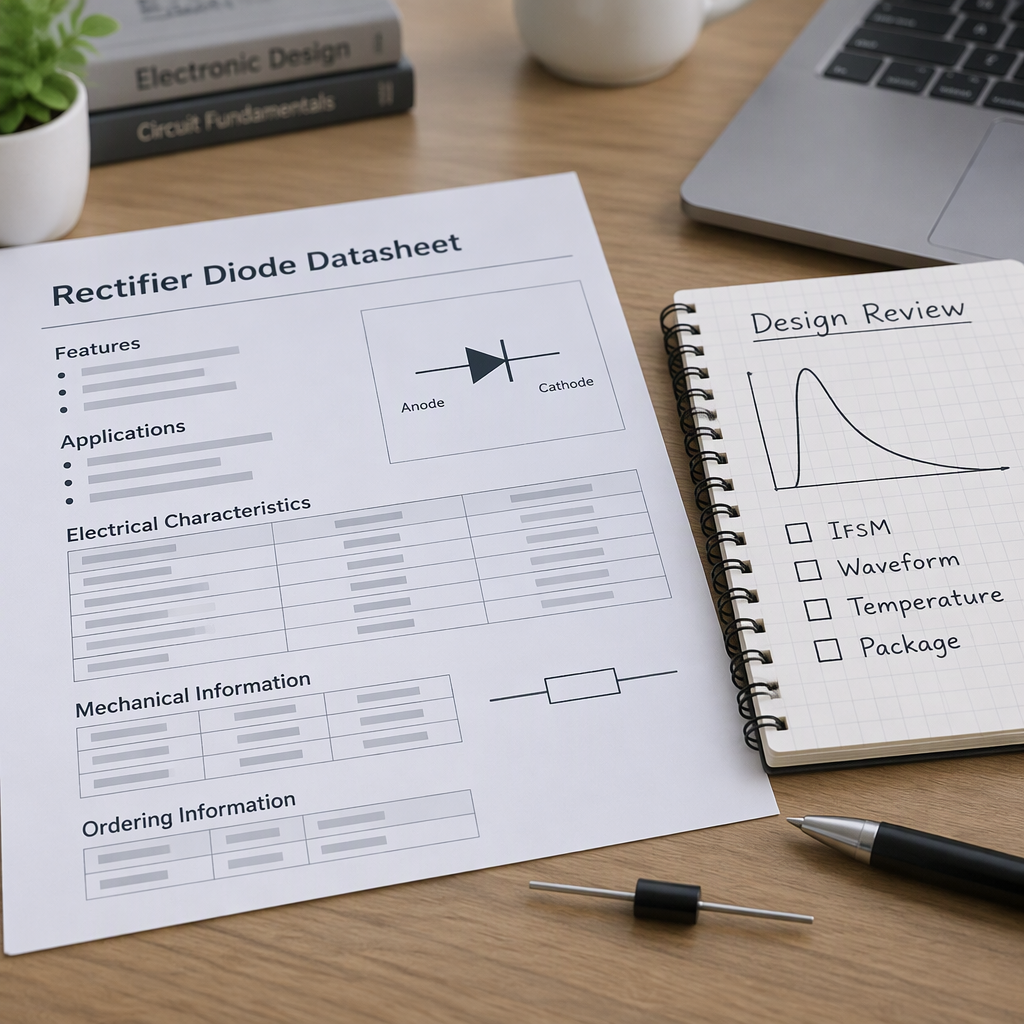
IFSM is the surge peak forward current term used for peak forward current that includes nonrepetitive transient currents and excludes repetitive transient currents.
The JEDEC dictionary entry for surge peak forward current defines IFSM in that nonrepetitive context and references semiconductor-device terminology documents.
For a buyer reading a rectifier diode datasheet, the first task is therefore not to copy the largest current number into the design file. The first task is to identify the exact rating name, the waveform or pulse assumption attached to it, the starting thermal condition and whether the event is described as a one-time surge or a repeated operating condition.
A nonrepetitive surge-current rating should not be treated as repetitive inrush capability because the IFSM definition separates nonrepetitive transient current from repetitive transient current.
The practical risk is a selection shortcut: a diode may appear acceptable when only the peak number is compared, while the real application repeatedly heats the junction during start-up, restart, line disturbance or capacitor recharge events.
In inrush design review, ask whether the event happens once during abnormal operation, occasionally during field use or many times across product life. If the inrush event is expected to repeat, the buyer should request the datasheet limits, derating information or supplier guidance that applies to repeated stress instead of relying only on IFSM.
IEC 60747-2:2025 is relevant background for rectifier-diode terminology, ratings, characteristics, measuring and test methods, type tests, routine tests, endurance tests and marking, but its public landing page does not prove that a particular supplier part meets every requirement.
The official page for IEC 60747-2:2025 identifies the standard as “Semiconductor devices - Part 2: Discrete devices - Rectifier diodes” and lists its scope for generic rectifier diodes, avalanche rectifier diodes, fast-switching rectifier diodes and Schottky barrier diodes.
Use the standard scope to frame the questions you ask, not to assume compliance for a model number. For purchasing release, request the current datasheet, applicable declarations, test basis and any model-specific qualification information directly from the supplier.
Before using a rectifier diode surge-current rating for inrush, compare the test condition behind the rating with the actual electrical and thermal condition in the application.
Condition to check | Why it matters for inrush selection | Buyer action before approval |
|---|---|---|
Rating name: IFSM or another surge term | IFSM is tied to nonrepetitive peak forward current, so the name limits how the number should be interpreted. | Match the datasheet term to the expected event type. |
Waveform and pulse duration | Rectifier-diode standards cover ratings, characteristics and measuring or test methods, so the condition attached to a rating is part of the selection context. | Compare the datasheet waveform with the measured or simulated inrush waveform. |
Starting temperature and thermal path | Ratings and tests are meaningful only when their stated conditions are understood. | Check initial junction or ambient assumptions, package, mounting and heat-spreading conditions. |
Number of events | A nonrepetitive transient-current term does not automatically cover repetitive transient operation. | Separate one-time surge review from repeated start-up or restart review. |
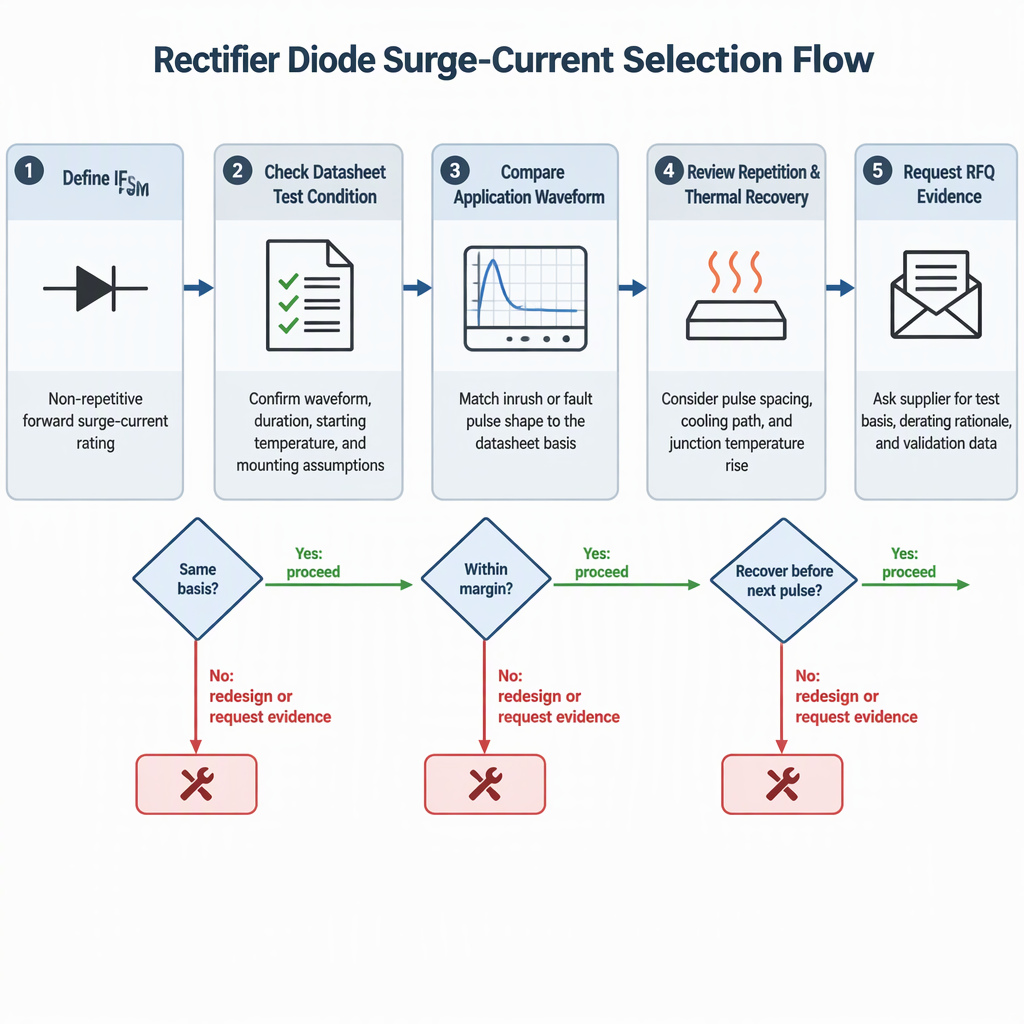
Read the surge-current line as one input in a sequence: define the event, identify the rating term, compare the test condition, review repetition and temperature, then request missing model-specific evidence.
Confirm whether the expected stress is a nonrepetitive event or a repeated inrush event during normal use.
Find the exact surge-current symbol and wording on the datasheet, especially whether IFSM is used.
Read the conditions attached to the rating, including waveform, duration, temperature, package and test context where provided.
Compare those conditions with the circuit’s rectifier position, source impedance, capacitor charging behavior, ambient range and cooling path.
If the event repeats, ask for guidance beyond a nonrepetitive IFSM value.
Keep the selected standard, datasheet revision and supplier response together in the engineering change or purchasing file.
A useful RFQ should give the supplier enough information to judge the application stress instead of asking only for a high rectifier diode surge current number.
State whether the inrush event is one-time, occasional or repetitive.
Provide the expected current waveform, pulse duration and number of pulses where available from measurement or simulation.
Share the operating temperature range, enclosure condition, PCB thermal path and package preference.
Ask for the datasheet revision, rating conditions, derating information and any applicable test basis for the proposed model.
Ask quality teams to record which standard or test method is being referenced, and which documents are required for incoming approval.
If considering Merry Electronic, keep the request at model and datasheet level; the company website supports rectifier diode as a product category, not a universal surge-current value for all models.
Merry Electronic can be discussed here only as a supplier website that lists rectifier diode among its product categories; model-specific surge-current performance must come from the relevant datasheet or supplier document.
The English homepage lists product lines or categories including Rectifier Diode, Rectifier Bridge, Schottky Diode, Silicon Carbide Diode, Transistor, Power Supply IC and Resistor.
For procurement, that category-level information is enough to decide that a rectifier-diode inquiry may be relevant. It is not enough to approve an inrush design, claim compliance, compare packages or release a part number without the model-specific documentation.
IFSM is not enough by itself to approve an inrush design because it identifies a nonrepetitive peak-current condition, while real applications also depend on waveform, repetition, temperature, package and test context.
Use IFSM to screen candidate rectifier diodes, not to replace application stress analysis.
Use IEC 60747-2:2025 as relevant rectifier-diode standards context, while asking for model-level documentation before approval.
Align R&D, quality and procurement around the same waveform, thermal assumptions, derating questions and document requirements before RFQ.
Most surge-current mistakes come from reading the peak number without the definition, test condition and application repetition pattern.
IFSM means surge peak forward current, a peak forward current term that includes nonrepetitive transient currents and excludes repetitive transient currents.
No. Inrush current is an application event, while IFSM is a device-rating term for nonrepetitive peak forward current. The two should be compared only after the event waveform and rating conditions are understood.
Do not assume that. Because IFSM excludes repetitive transient currents, repeated start-up needs additional datasheet information or supplier guidance for repetitive stress.
IEC 60747-2:2025 is a current rectifier-diode standard covering terminology, ratings, characteristics, measuring and test methods, tests and marking for several rectifier-diode categories.
No. A standards page explains scope and status; compliance for a selected part requires the supplier’s model-specific datasheet, declaration or test documentation.
Procurement should ask for the current datasheet, rating conditions, derating information, applicable test basis and any model-specific confirmation that matches the engineering waveform and thermal assumptions.
Merry Electronic lists rectifier diode as a product category on its English website, so it can be considered for a relevant inquiry; final selection still depends on the specific model documentation.


